
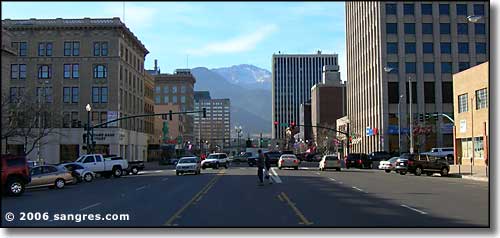
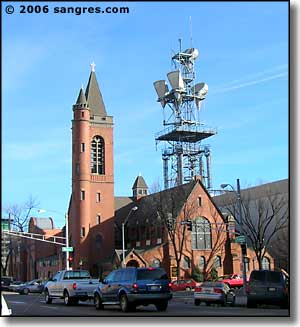
A lot of folks think that Colorado Springs is a city dominated by military bases (Fort Carson, the Air Force Academy, Peterson AFB, NORAD, etc.), the US Olympic Center and the headquarters of so many fundamentalist and evangelical Christian organizations, but the city is home to so much more than that. From Colorado's gold and silver mining heyday there is a legacy of institutions first built by the original mining millionaires that are now being supported and expanded by descendants of the old gold and silver barons (Pueblo is another city where some of the coal, steel and cattle barons took up residence but you don't see as much modern investment there by their descendants).
The Colorado Springs Metropolitan Statistical Area is a rich and vibrant community of more than 400,000 people of all stripes, creeds and colors. Because of the incredible population growth over the last 20 years, the I-25 through town seems to have been under continual construction for at least 10 years now and the CosMix project currently (2007) under way has at least another year before the heavy equipment gets moved to somewhere else and those new traffic lanes at the north end of the city are opened to us.
There are many charitable institutions in Colorado Springs that seem to be very well funded, a testament to the giving nature of Colorado Springs "natives." I have never seen a Humane Society Animal Shelter the likes of what Colorado Springs has built, entirely with donated money. The city is clean and has a very diverse population. I know that I mentioned evangelical Christians above but Colorado Springs is also home to the Gay and Lesbian Alliance of Colorado, a group that supports and funds a large number of "straight" cultural events and organizations. I also know that these two groups are officially "somewhat at odds" with each other but on a regular basis, the media is full of stories showing the incredible (but hidden and denied) links between both groups and their differing lifestyles.
I live 130 miles away but all my radios are tuned to KRCC, an NPR station run by Colorado College (an excellent liberal arts school with its campus just north of downtown). Like most NPR stations, KRCC runs a spring and fall fund-raising drive. Unlike most NPR stations, KRCC has distinguished itself nationally for the rapidity with which they attain their stated goals, again attesting to the giving nature of Colorado's people and to our level of support for KRCC's excellent programming.
In 2006, Money magazine selected Colorado Springs as the Number 1 Best Big City in their article on "Best Places to Live."
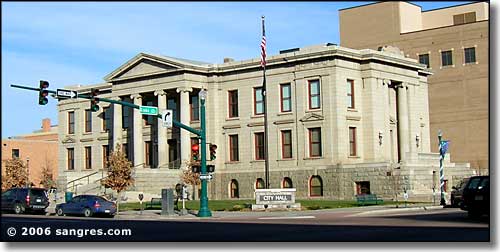
Colorado Springs City Hall, dwarfed by the Municipal Court to the right
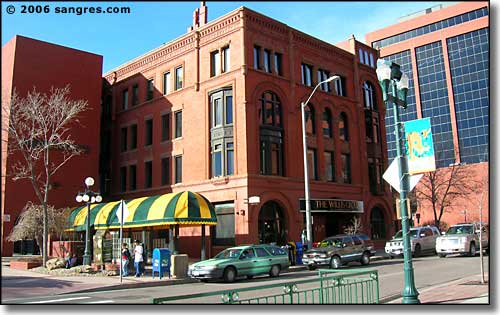
Nice refurb of an old Victorian office building
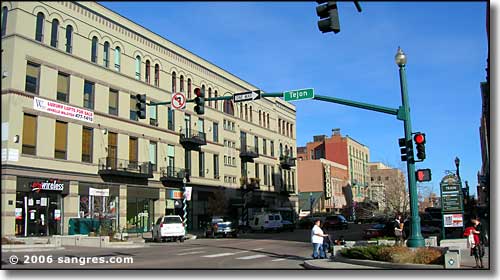
Another nice refurb with lofts for sale
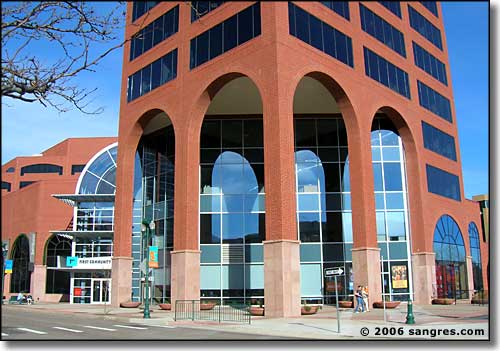
The Plaza of the Rockies
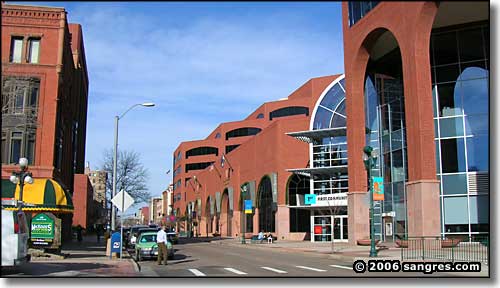
The Plaza of the Rockies
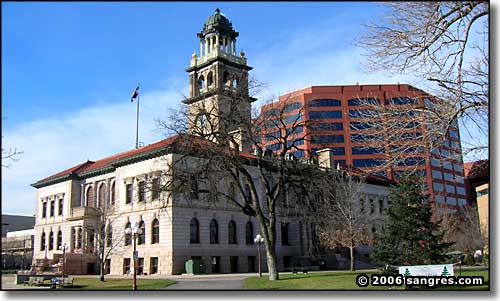
Colorado Springs' Pioneers Museum
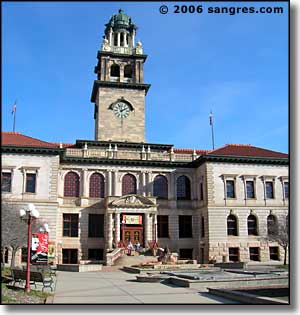
Colorado Springs has many older edifices scattered around town, remnants from the opulence of the mining heyday. The Pioneers Museum is one of those in the heart of downtown (pictured to the right). Excellently redone with great displays, I highly recommend it to anyone interested in the nitty-gritty's of Colorado history.
On the west side of town is Old Colorado City, an area that looks very much as what we might envision "Old Colorado City" should look like. The character and theme of the neighborhood is to show some of the color and opulence of Colorado's mining boom during the Victorian era.
Colorado Springs was founded by General William Palmer in 1871. He bought a huge tract of land just to the east of Colorado City, and intended to create a "high quality resort" community here at the foot of Pike's Peak with the Garden of the Gods nearby. His flagship hotel, the Antlers, opened for business in 1873 and brought in tourists from around the world. A couple years later General Palmer founded the Denver & Rio Grande Railroad, an enterprise that tied together a lot of southern Colorado and brought all that business into a thriving Colorado Springs.
In 1891, Winfield Scott Stratton discovered and developed a huge gold strike in the Cripple Creek-Victor area. Much of the ore produced there was carried to Colorado City for processing on Palmer's railroad. Stratton bought land from Palmer and donated it for the Post Office, the Courthouse (which is now the Pioneer Museum) and City Hall. He also built the Mining Exchange building, donated land for parks and funded the Myron Stratton Home for the elderly and for itinerant children (which section is now used for the treatment of severely abused and disturbed children).
Early photos of Colorado Springs show a city laid out with wide streets and a number of large stone buildings (the library, the courthouse, Colorado College and others) built and occupied but sitting in the middle of open and empty prairie: the city's infrastructure was being grandly built in stone before there was a population to support it.
Spencer Penrose is another early mining magnate who left his mark on Colorado Springs. He financed construction of the Cheyenne Mountain Zoo, the Broadmoor Hotel, the Pikes Peak Highway, Will Rogers Shrine of the Sun, and what became Penrose-St. Francis Health Services.
Shortly after the attack on Pearl Harbor, Colorado Springs saw its first military base established at Camp Carson. Then the Colorado Springs Municipal Airport became Peterson Field and was used as a training base for heavy bomber crews during the war. When the war ended, the military started to close down these bases but changed their minds when the Korean conflict began. In 1951, the United States Air Defense Command relocated to Ent Air Force Base in Colorado Springs. In 1954, President Eisenhower chose a site just north of Colorado Springs to build the Air Force Academy. In 1963, NORAD moved into the underground facility built inside Cheyenne Mountain. In the mid-1970's, Ent Air Force Base was decommissioned and became the United States Olympic Training Center. In 1983, Falcon Air Force Base (later renamed Schriever Air Force Base) was commissioned and charged with satellite control and missile defense. The Air Force Space Command is located at nearby Peterson Air Force Base.
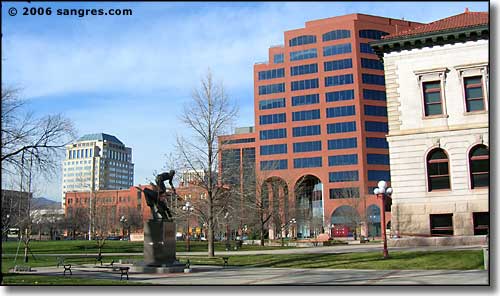
The Plaza in front of the Pioneers Museum
Special Attractions
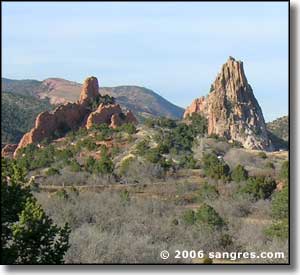
The Garden of the Gods is a city park on the northwest side of town. The big stars in the park are the spires and fins of Dakota sandstone sticking up out of the ground, remnants of the mountain-building action that pushed up the Front Range (and Pikes Peak) about 65,000,000 years ago. This area has been pretty well preserved since the first Europeans arrived in the area: they recognized the grandeur and sacredness of the site and didn't just destroy it in their insatiable thirst for mineral wealth. However, do you see that slope behind the rock formation on the left side of the photo? That's a mining legacy left over from the days when almost anything was allowed in terms of ripping the minerals from the ground. In those days, once the minerals were gone, the miners just went away and left their mess behind. The clean-up on this particular hillside has been going on for many years now...
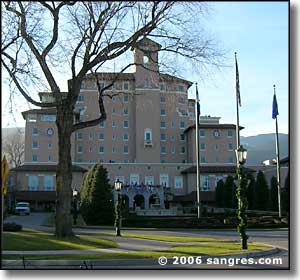
I think the Broadmoor was first built as a high-end sanitarium for consumptives (the old name for folks with tuberculosis). In the 1800's and early 1900's a lot of people came to Colorado for the "cure." While living here wasn't exactly a "cure" for tuberculosis, the clean, dry air was healthy enough to allow the folks to finish out their final days in some sort of reasonable comfort. I'm continually amazed at how prevalent in Colorado was the practice of renting to consumptives and caring for them until they passed on. A lot of our history books overlook this but it was a major business in the old days. And the problem was so prevalent in the eastern cities that Colorado was far more than just a breath of fresh air... it was a promise of brighter futures for the infected. As the tuberculosis bacteria has no respect for social status or strata, those with the money built places where they could care for their own, for a good profit, of course. In that respect, the Broadmoor has been a 5-star country club/resort/health spa from day one, and that tradition continues today.

