 |
Craters of the Moon National Monument |
 Looking out over Craters of the Moon Wilderness at Craters of the Moon National Monument |
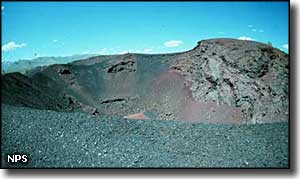
Craters of the Moon National Monument and Preserve is comprised of 714,727 acres of a relatively new and well-preserved flood basalt area on the edge of the Snake River Plain in eastern Idaho. Contained on the property are three major lava flows and about 400 square miles of sagebrush/grasslands steppe. All three lava fields are products of the Great Rift of Idaho, an open (and still active) rift crack in the surface of the Earth. There are places at Craters of the Moon where the rift crack is up to 800 feet deep. The Great Rift is a crack in the Earth's crust resulting from the Basin and Range uplifting and rifting millenia ago. The rift extends almost all the way across the Snake River Plain. There are 60 distinct lava flows on the property ranging in age from 15,000 years ago to 2,000 years ago. The Shoshone have legends about a serpent on a mountain being angered by lightning. The serpent coiled around the mountain and squeezed until fire shot from the cracks and liquid rock flowed out. Archaeological evidence in the area shows the Shoshone were present during the time of at least the most recent lava flows. Geologists say the field is presently dormant but expect more eruptions sometime over the next 1,000 years. Historically, lava flows occur every 500 to 3,000 years and flow for up to 1,000 years each time. The original cause of the uplift and lava flows is thought to be the presence of the magma hot spot that is presently situated beneath the Yellowstone Caldera. Activity still happens on the Snake River Plain because there is still significant heat in the ground and fault lines in the crust allow that heated magma and contained energy to easily flow upward. 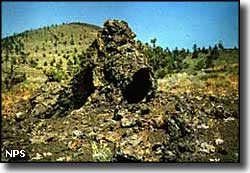
Early Euro-American pioneers avoided the area because the lava made the ground extremely treacherous to travel on. It was 1901 before a geologist tried to explore the property, the end of World War I before anyone got serious about it. President Calvin Coolidge proclaimed the National Monument finally in 1924 and it has been expanded several times since. The 43,243 acres of Craters of the Moon Wilderness are managed by the National Park Service as part of the Craters of the Moon National Monument in eastern Idaho. This is a large roadless area because of the broken-ness of the topography: more than 2,000 years ago, large amounts of basalt lava were distributed across about 700 square miles of Idaho along the Great Rift. There are numerous hidden ice caves and lava tubes among all the spatter cones and cinder cones in the Craters of the Moon Wilderness. Because of the ruggedness of the topography and the surface material, hiking is hard and horseback riding is not recommended. Compasses don't work among the lava flows because of the level of magnetism inherent in the rock. Topographic maps are essentially useless because this is an area of large lava flows: the extreme level of microtopography just doesn't appear at the scale maps are done in. If you are out here in the fog, stay put: you can't see anything and the ground is so incredibly broken... Some eruptions at Craters of the Moon were gassy, and bubbly rocks were ejected hundreds of feet into the air, often falling back to ground and forming cinder cones around the vents. Less gassy eruptions resulted in simple flows of sheets and rivers of peanut-butter-consistency olivine basalt which inched its way along over the surface, twisting, congealing and breaking into jumbled masses of jagged rock. You'll also find spatter cones and lava tubes scattered among the 25 cinder cones and eight fissures and fissure systems. USGS scientists have determined that the main lava flows seem to occur on average every 2,000 years (meaning it's about time once again). And between 6,000 and 8,000 years ago, the lava flows almost doubled in volume from what they had been previously. 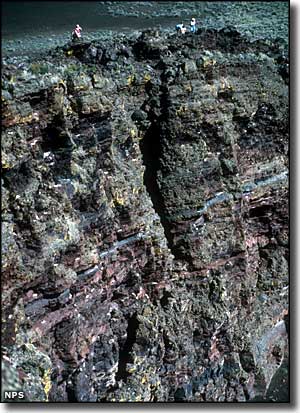
The Great Rift volcanic zone is a two-mile-wide zone of linear surface cracks that tend to run northwest to southeast (N35°W) across most of the eastern part of the Snake River Plain. This whole area of Idaho is contained within the Picabo Volcanic Field. This is also an area where there is no surface water. Today, the property is a mix of National Park Service land and Bureau of Land Management property. The National Monument & Preserve is co-managed by both services. In 1970, 43,243 acres of the National Park Service property were set aside by Congress as Craters of the Moon National Wilderness. At this point, Craters of the Moon National Monument & Preserve contains nearly all of the three major lava flows and most of the Great Rift Zone. The original effort was to make the entire property a National Park but opposition from hunters and cattle ranchers led to a compromise that created the Preserve as a place that allows hunting and cattle grazing (neither of which are allowed in National Parks or Monuments). Craters of the Moon National Monument & Preserve is open year round. However, winter snows can limit access around the Loop Road from mid-November through mid-April. The property itself is open 24 hours a day but the visitor center is only open from 8 am to 4:30 pm daily (8 am to 6 pm from Memorial Day weekend through September 12). The visitor center is also closed on Federal holidays during the winter season. The entrance fee is $8 per vehicle. Folks on foot, bicycle or motorcycle pay $4 per person. People under 16 years of age enter free. Commercial tour vehicles also pay fees. When the Loop Road is closed there is no entrance fee. All National Parks Passes, Golden Eagle, Golden Eagle Hologram, Golden Access and Golden Age Passports are honored according to the provisions of each pass. There is a developed (water but no hookups) 52-site campground available just beyond the visitor center. Sites are available first come, first served. Rates are $10 per night per site, $6 per night per site when no water is available (early and late season). No fires are allowed. Self-registration is at the campground, no reservations are available. There is a separate group campground available for $30 per night, call the park for info. The nearest lodging and food services are in Arco, 18 miles east of the visitor center. |
 Craters of the Moon Wilderness 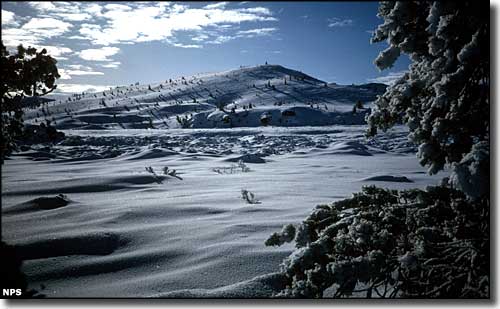 North Crater in the winter 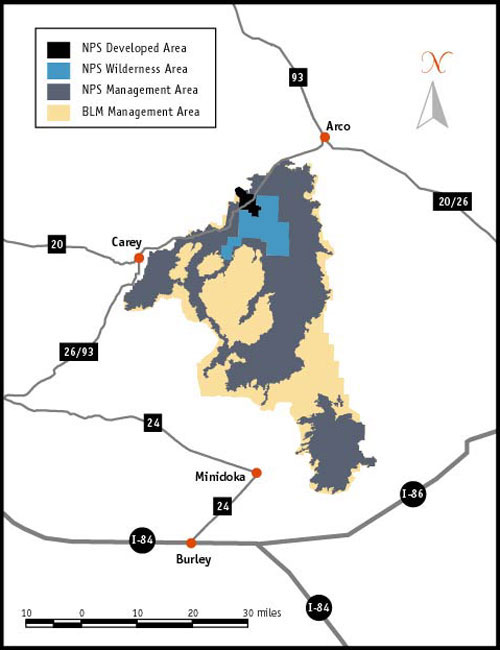 Map showing location of Craters of the Moon National Monument and Wilderness  Craters of the Moon National Monument area map |
|
|
 |
| Index - Arizona - Colorado - Idaho - Montana - Nevada - New Mexico - Utah - Wyoming National Forests - National Parks - Scenic Byways - Ski & Snowboard Areas - BLM Sites Wilderness Areas - National Wildlife Refuges - National Trails - Rural Life Advertise With Us - About This Site - Privacy Policy |
| Photos and map of Craters of the Moon Wilderness are courtesy of the National Park Service Area map courtesy of National Geographic Topo! Text Copyright © by Sangres.com. All rights reserved. |
